1. Overall Nonpublic Enrollment.
In May 2026, the New York Department of Education released updated enrollment data for New York nonpublic schools for the 2025-26 school year.
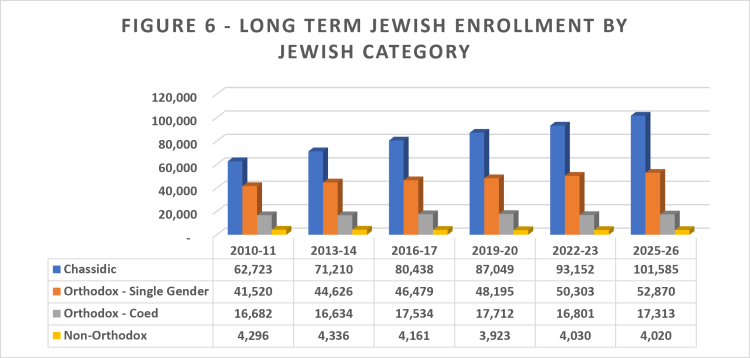
In the 2025-26 school year, K-12 enrollment in New York nonpublic schools fell to 379,048 – a decrease of 3,409 students (-0.9%) compared with the prior year. As illustrated in Figure 1, this decline follows a short upward trend that began in the 2023–24 school year, following an eight-year run of sustained enrollment decline.
While total enrollment remains well below its 2010 peak, the recent pattern marks a relative stabilization from the continuous losses experienced between 2014 and 2020.
2. Enrollment Trends in Jewish Schools.
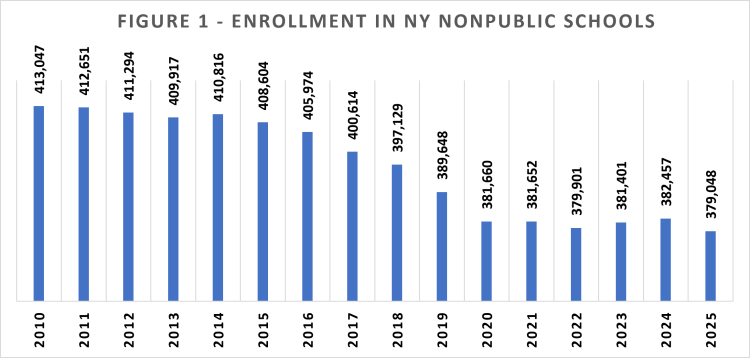
Enrollment in Jewish schools increased by 3,115 students in 2025–26, representing a 1.8% year over year gain. This marks a slight deceleration from the prior three years when the average annual growth rate was 2.2%.
3. 2025-26 Jewish Enrollment Change by Region.
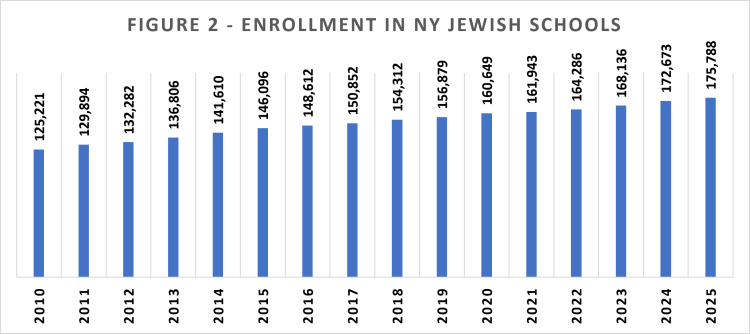
In 2025-2026, growth in New York Jewish schools was concentrated in two regions: NYC and Monsey. Most other regions saw moderate or minimal growth, while two regions saw declines.
The largest increases occurred in Monsey (+1,904, +5.3%) and New York City (+1,587, +1.5%).
There were also moderate increases occurred in the Catskills (+167, +13.6%) and Long Island (+95, +1.1%).
Minimal gains were recorded in Westchester (+16, +0.8%), Rochester (+18, +7.2%), and Albany (+15, +8.8%).
In contrast, enrollment declined in Other Areas (–6 students, –4.4%) and Monroe (-681, -3.7%). Overall, recent regional trends show growth concentrated in select areas, partially offset by declines in a smaller number of regions.
4. 2025-26 Jewish Enrollment Change by Affiliation.
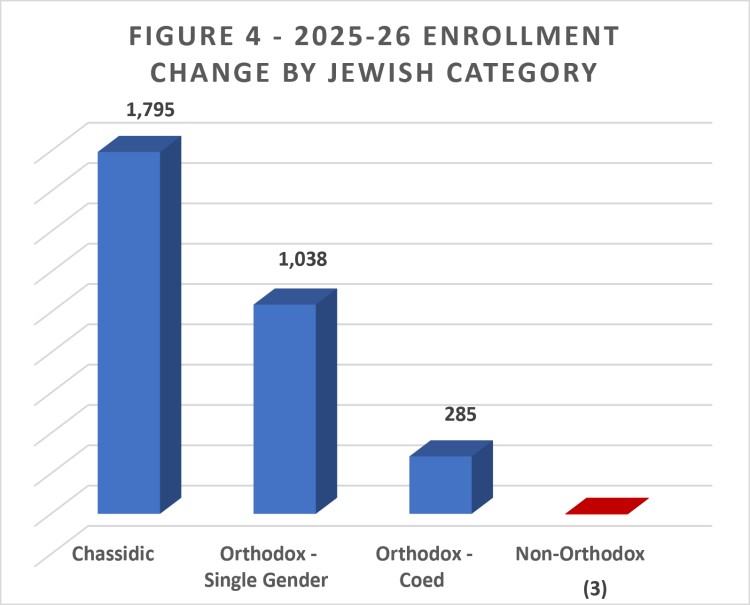
Chassidic Schools saw the largest enrollment growth, with an additional enrollment of 1,795 students (+1.8%).
Yeshivish Schools – defined as Orthodox schools where students are gender-segregated – saw significant enrollment growth with an additional enrollment of 1,038 students (+2.0%).
Modern Orthodox Schools – defined as Orthodox schools that are coed – saw moderate growth of 285 students (+1.7%).
Non-Orthodox Schools had static enrollment, with a negligible decrease of -3 students (-0.1%).
5. Long-Term Jewish Enrollment Trends by Region.
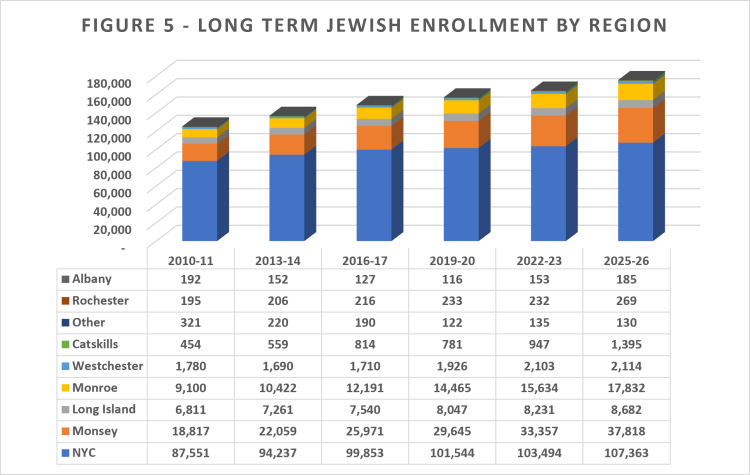
Growth in Jewish schools since 2022-23 occurred in all regions except one. The largest increases since 2022-23 occurred in Monsey (+4,461, +13.4%), New York City (+3,869, +3.7%), and Monroe (+2,198, +14.1%). Additionally, moderate increases were seen in Long Island (+451, +5.5%), and Catskills (+448, +47.3%).
In contrast, enrollment was minimal since 2022-23 in several regions, including in Rochester (+37, +15.9%), Albany (+32, +20.9%), and Westchester (+11, +0.5%), while Other Areas saw a negligible decrease in enrolment (-5, -3.7%).
Overall, enrollment has increased steadily over time, with most of the growth coming from larger regions like NYC, Monsey, and Monroe. While many areas saw gains, the growth was not evenly spread – some smaller regions experienced declines or more uneven patterns. As a result, overall growth was strong but concentrated in a few key areas rather than across all regions.
6. Enrollment Trends by Jewish Affiliation.
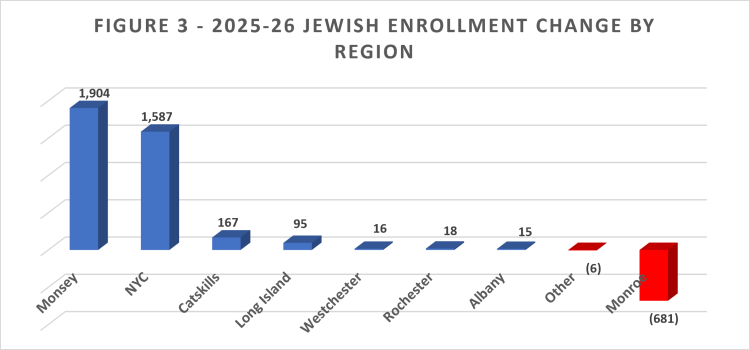
Changes in Jewish school enrollment since 2022–23 varied sharply by affiliation.
Chassidic Schools saw the largest enrollment growth, with an additional enrollment of 8,433 students (+9.1%) reaching a total of 101,585 students. This represents the largest gain among all affiliation groups and continues a long term pattern of sustained expansion in this sector since 2022–23.
Yeshivish (Orthodox, single gender) schools also saw substantial growth, with enrollment increasing by 2,567 students (+5.1%), achieving a total enrollment of 52,870.
In contrast, Modern Orthodox (Orthodox, coeducational) schools recorded modest growth, increasing by 512 students (+3.0%) to 17,313.
Non Orthodox schools experienced a negligible decline, with enrollment decreasing by 10 students (–0.2%) to 4,020.
Overall, the 2025–26 enrollment increase in New York Jewish schools was driven largely by continued growth within the Chassidic sector and Yeshivish sector, while enrollment in other affiliation groups saw modest growth or declined slightly, reinforcing an uneven pattern of growth across the Jewish education landscape.