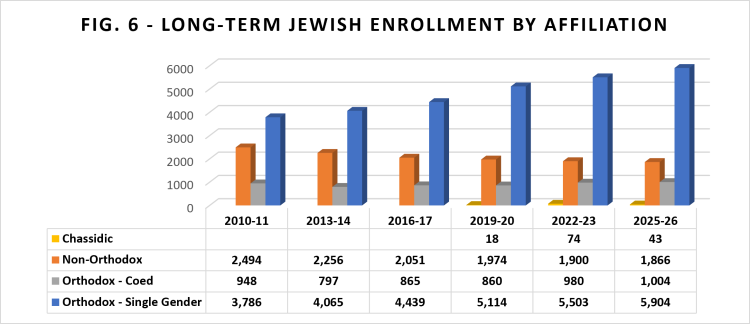
Recently, the Maryland Department of Education released updated enrollment data for Maryland nonpublic schools. This data reflects the enrollment published in April 2026, for the 2025-2026 school year.
1. Overall Nonpublic Enrollment.
In September 2025, MD K-12 nonpublic school enrollment was 103,627 – a minor decrease (-2.1%) from the previous year’s enrollment of 105,838. This is the third consecutive year of decline following a peak of 111,622 students in 2022-23 – the highest enrollment level in the eighteen years of available data. Enrollment has fallen 7.7% since that peak.
2. Enrollment Trends in Jewish Schools.
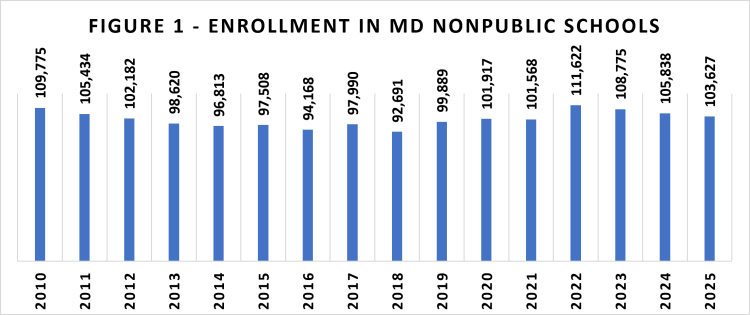
In the 2025-26 school year, Jewish enrollment in Maryland reached 8,817, marking the highest level since the 2010-2011 school year. Since the 2013-14 school year, Jewish enrollment has grown for twelve consecutive years, with an average annual growth rate of 1.8%.
This continued growth reflects a healthy pipeline of students. A closer look at the components of that growth – new students entering the youngest grades versus losses among continuing students – is shown below.
3. 2025-26 Jewish Enrollment Change by Region.
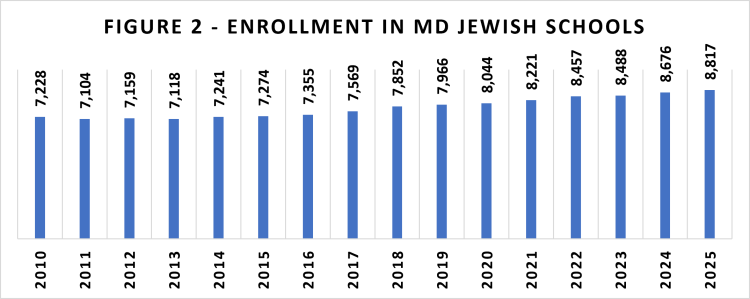
Growth in Jewish schools over the past year was concentrated in the Baltimore Area (+120, +1.9%), consisting of schools in Baltimore City and Baltimore County.
We saw modest growth in the Montgomery County Area (+16, +0.7%), consisting of schools in Bethesda, Rockville, and Silver Spring.
For the first time a new Jewish school was reported in Columbia: Tamim Academy enrolling five Kindergarten students. The single Jewish school in Washington D.C. – the Milton Gottesman Jewish Day School – is not accounted for in this report.
4. 2025-26 Jewish Enrollment Change by Affiliation.
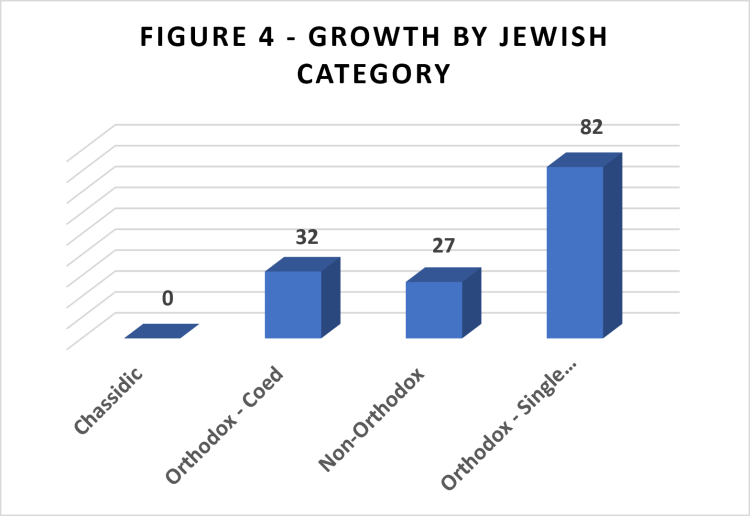
Most Jewish categories grew in 2025-26.
Orthodox – Single Gender Schools (referred to as Yeshivish in the prior report) – defined as Orthodox schools where students are gender-segregated – grew by 82 students (+1.4%).
Orthodox – Coed Schools (referred to as Modern Orthodox in the prior report) – defined as Orthodox schools that are coed – grew by 32 students (+3.3%).
Non-Orthodox Schools grew by 27 students (+1.5%).
No growth was observed in Chassidic Schools.1
1Cheder D’Kahal Chassidim is Maryland’s only Chassidic school in the dataset (43 students in 2024-25). Enrollment data was not available for 2025-26 so the previous year’s enrollment was used as an estimate and shifted up one year.
5. Long-Term Jewish Enrollment Trends by Region.
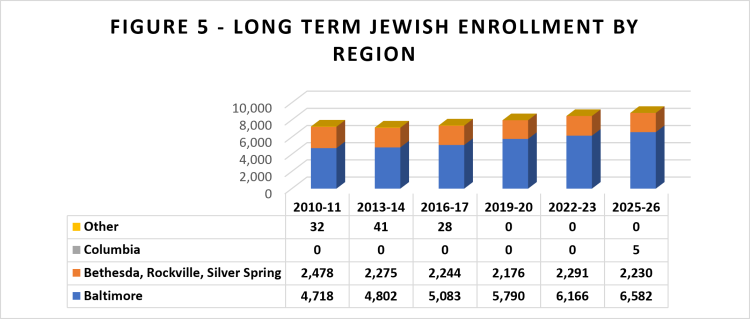
Growth in Jewish school enrollment since 2022-23 was concentrated almost entirely in the Baltimore Area (+416 students, +6.7%). In contrast, enrollment declined since 2022-23 in the Montgomery County area (-61 students, -2.7%), which includes Bethesda, Rockville, and Silver Spring.
6. Enrollment Trends by Jewish Affiliation.
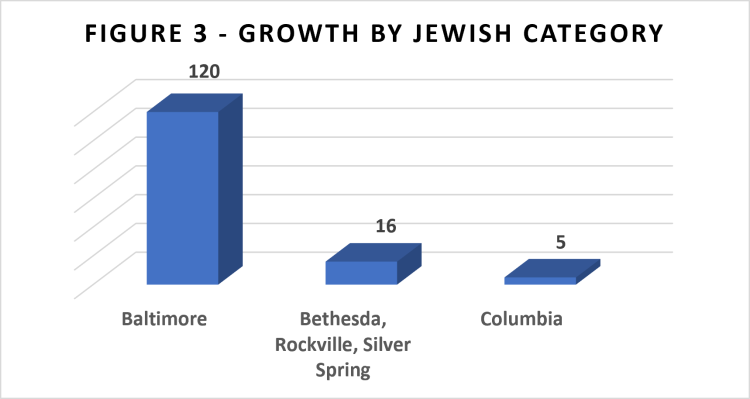
Changes in Jewish school enrollment since 2022-23 varied substantially by affiliation. Yeshivish (Orthodox, single-gender) schools accounted for nearly all enrollment growth, increasing by 401 students (+7.3%) to 5,904 students in 2025-26. This was the largest increase among all affiliation groups and continues a long-term pattern of sustained growth in the Yeshivish sector.
Modern Orthodox (coeducational) schools experienced modest growth, increasing by 24 students (+2.4%) to 1,004 students. In contrast, Non-Orthodox schools declined by 34 students (-1.8%) to 1,866 students, while Chassidic schools decreased by 31 students (-41.9%) to 43 students. Although the percentage decline among Chassidic schools was large, the change represented a relatively small number of students.
Overall, recent enrollment growth was driven almost entirely by gains in the Yeshivish sector, while enrollment in other affiliation groups remained stable or declined slightly, reinforcing an a long-standing pattern of growth in Jewish schools nationwide.